
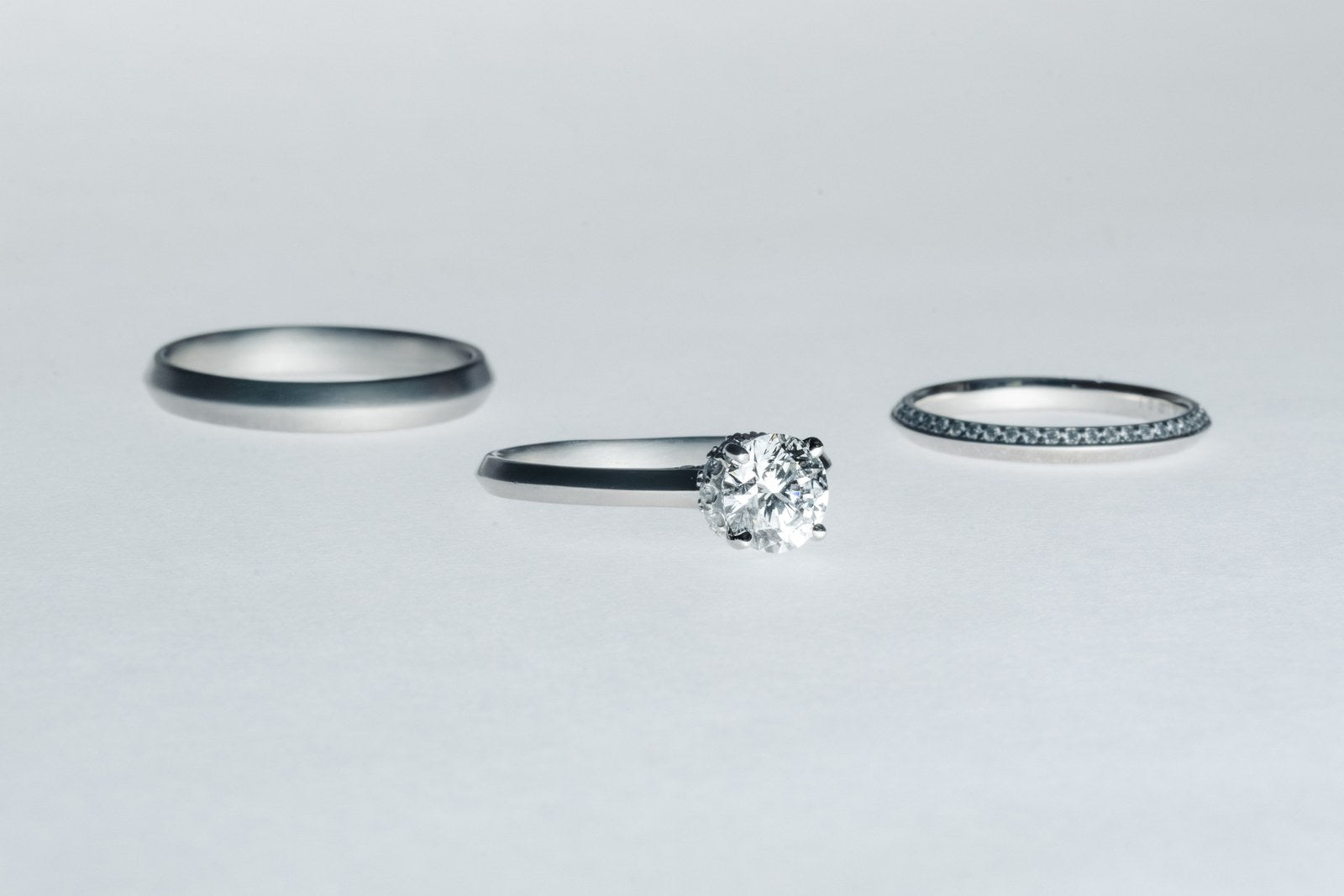


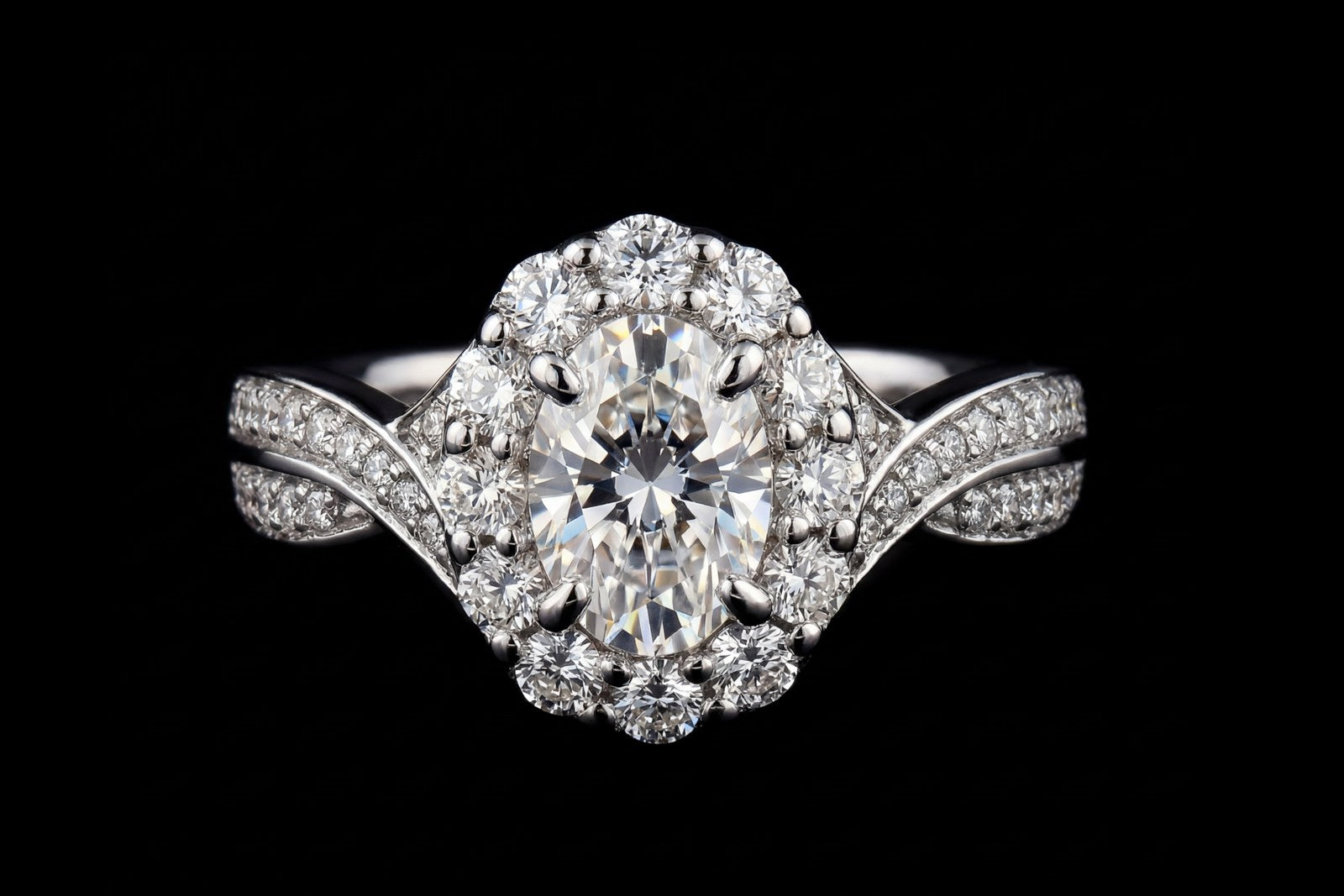


"Would someone who knows stones be able to tell?" This is the question we are asked most often by people considering a lab grown diamond.
There is a clear answer. And once you know why that answer holds, most of the hesitation tends to fall away. This is written to help you decide, not simply to reassure you.
THE ANSWER
Neither the naked eye, nor a ten power loupe, nor the trained eye of a gemmologist can tell a lab grown diamond from a natural one. They are the same crystal of carbon. Only the analytical instruments of a grading laboratory can make the call.
- The answer. Neither the eye nor a loupe can tell
- Why they cannot be told apart
- How a lab grown diamond is made
- What a laboratory actually looks at
- The laser inscription on the girdle
- Stones that are not diamonds at all
- When someone asks whether it is real
- Why we chose this stone
- Frequently asked questions
The answer. Neither the eye nor a loupe can tell
A lab grown diamond cannot be distinguished from a natural diamond with the naked eye. Look through a ten power loupe and the result is the same.
Even a gemmologist cannot judge it by sight. This is not a question of experience or of good eyes. The information needed to make the judgement simply does not exist within the visible range. The judgement becomes possible only with dedicated analytical equipment.
| Method | Verdict |
|---|---|
| With the naked eye | Not possible |
| With a ten power loupe | Not possible |
| A gemmologist looking at the stone | Not possible |
| Reading the girdle inscription under magnification | Possible where an inscription exists |
| Analytical equipment at a grading laboratory | Certain |
You will sometimes read that an expert can tell at a glance. That is not accurate. The instrument can tell. The eye cannot.
Why they cannot be told apart
A diamond is a crystal in which carbon atoms are bound in four directions in a cubic structure. A lab grown diamond is the very same carbon, arranged in the very same structure.
| Property | Natural and lab grown |
|---|---|
| Chemical composition | Carbon. Identical |
| Crystal system | Cubic. Identical |
| Mohs hardness | 10. Identical |
| Refractive index | About 2.417. Identical |
| Dispersion, the strength of the rainbow fire | About 0.044. Identical |
A stone appears brilliant because light enters it, reflects inside it and returns to the eye. That path is decided by the crystal structure and the refractive index, and by nothing else. When those two are the same, the light that returns is the same. They are not merely similar. They are optically identical.
In gemmology both are treated as diamond. What is distinguished is not the species but the origin. International rules require that a lab grown diamond be sold as such, not because the quality is lesser, but because origin is information the buyer is entitled to have.
We explain how these stones come into being in What Is a Lab Grown Diamond, and how they compare with natural stones in Lab Grown and Natural Diamonds.
How a lab grown diamond is made
Knowing how these stones are grown makes the rest of this article easier to follow. There are two methods.
HPHT, high pressure high temperature
This method builds an environment close to the inside of the earth inside a machine. At around 1,300 to 1,600 degrees Celsius and pressures above 50,000 atmospheres, a crystal is grown on a small seed diamond within molten metal that carries the carbon. It helps to think of it as the work of the earth, with only the time shortened.
CVD, chemical vapour deposition
A near vacuum chamber is filled with a carbon bearing gas such as methane. Plasma breaks the gas apart, and carbon atoms settle one layer at a time onto a thin plate shaped seed. The crystal grows slowly, layer upon layer. Most of the larger stones used in bridal jewellery are grown this way.
Either way, what grows is a real diamond. And either way, the manner of its growth leaves traces inside the stone. Those traces are what a laboratory looks at.
What a laboratory actually looks at
The evidence lies not in beauty but in the record of how the stone grew. Four things are read.
Growth structure
A natural diamond grows in the octahedral directions deep in the earth. A stone grown by HPHT develops several faces at once, so distinct sectors appear across a cross section. A stone grown by CVD keeps a striped record of the layers laid down one after another.
None of this is visible in ordinary light. Under an instrument that floods the stone with ultraviolet light and images how it glows, the patterns stand out clearly. This is one of the strongest pieces of evidence a laboratory uses.
The state of the nitrogen
This may be the most fundamental difference of all.
Most natural diamonds contain a trace of nitrogen, and over time those nitrogen atoms drift together into groups. That gathering requires the stone to sit at high temperature for an unimaginable stretch of time. It does not happen in days or in weeks.
A lab grown diamond has no such state. Stones grown by CVD are often TYPE IIa, containing almost no nitrogen at all, and in stones grown by HPHT the nitrogen remains scattered, still in its unassembled form.
What the instrument reads, in other words, is a record of how much time the stone has lived through. That the clue should be time itself is, we think, the most accurate and the most interesting part of this whole subject.
The way the stone luminesces
Shine light of a particular wavelength onto a stone and it glows in response. Split that light into a spectrum and the fine structures within the crystal become readable. Stones grown by CVD can show a signal that comes from silicon. Stones grown by HPHT can hold a blue green afterglow once the ultraviolet light is switched off. Natural stones have characteristics of their own.
Minute metallic inclusions
Because HPHT uses metal to dissolve the carbon, very small fragments of that metal are sometimes trapped inside the stone. In a natural diamond this does not happen.
None of these can be read without dedicated instruments. Put the other way round, with the instruments the answer is certain. There is no need to worry about stones being passed off as natural. Stones in the market pass through screening equipment at the laboratories and at each stage of the trade.
The laser inscription on the girdle
There is one clue you can check without any instrument.

Most lab grown diamonds carry the words LAB GROWN, or a report number, laser inscribed on the girdle, the widest band around the side of the stone. It is far too fine to see with the naked eye, but under magnification it can be read. Compare it with the number on the certificate and you can confirm that the stone in your hand and the record belong to each other.
The inscription exists to declare, not to conceal. IGI and the other laboratories grade these stones on exactly the same 4C scale as natural diamonds, and state on the certificate that the stone is lab grown. A grade means what it has always meant.
We have set out how the laboratories differ from one another in Lab Grown Diamond Certificates, and how to read the 4C themselves in How to Read the 4C of a Diamond.
Stones that are not diamonds at all
Everything so far has been about one diamond against another. There are also stones that resemble a diamond closely and are made of an entirely different substance. With those, the situation changes.

Moissanite is silicon carbide. Its hardness is 9.25, softer than diamond, and its dispersion is more than twice as strong. The rainbow fire comes out so forcefully that to an accustomed eye it looks like too much light. It is also doubly refractive, so under magnification the edges inside the stone can appear as two lines rather than one.
Cubic zirconia is zirconium oxide. Its hardness is around 8.5, so everyday wear leaves fine scratches on the surface. Its specific gravity is about 1.6 times that of diamond, which means that at the same size it feels noticeably heavier in the hand.
Between a diamond and these stones, in other words, clues remain even without instruments. The distinction that really deserves care is not natural against lab grown, but diamond against not diamond. We go into it in Moissanite, Cubic Zirconia and Diamond.
When someone asks whether it is real
If the question is whether it is a diamond, the answer is yes. It is a crystal of carbon, its hardness is 10, and a grading laboratory issues a certificate describing it as a diamond.

What the person asking usually wants to know is something else. Whether it is natural or lab grown, and what it cost. You are under no obligation to answer either. If you want to, you can say that it is a lab grown diamond, and there the conversation ends.
It is worth adding that the information is already public. Since it is stated on the certificate and inscribed on the stone, being lab grown is not a hidden fact but a recorded one. There is no need to prepare an explanation for something you were never hiding.
What reaches the eye of the person in front of you is the light that a crystal of carbon has returned. Light does not speak of where it was born.
Why we chose this stone
So far we have kept to the facts of whether these stones can be told apart. We would like to end by saying why we work with them.

To be clear at the outset, we do not treat a lab grown diamond as a substitute for a natural one. We offer it as one choice, and as diamond jewellery for a new era. There are three reasons.
01It does not depend on mining
Consider how much earth has to be moved to obtain a single diamond. Land that has been opened up does not return to the shape it held before. A lab grown diamond does not require that step. The same substance can be held in the hand without taking anything new out of the ground.
This is why we do not confine the idea to the stone alone. At ANNA DIAMOND we use refined metal drawn from urban mining, recovered from the metal resources inside discarded mobile phones and computers.
More than seventy percent of the gold and silver in the earth is said to have been mined already, and the quantity sleeping in urban mines is thought to be greater than what remains underground. Rather than digging further into what little is left, we would rather lift what humanity has already discarded back into jewellery. We believe that is a step worth passing on to the next generation. We describe it in our urban mining guide.
02We can speak for its origin
The route a diamond travels is remarkably long. Between the land it was dug from and the ring on a finger lie several countries and many hands, and along the way the question of where the stone came from grows harder to see. International certification schemes have been built, and tracing technology has advanced in recent years. We have written about that in The Transparency Revolution in Natural Diamonds.
What matters to us, on top of all that, is whether we can speak for the stone ourselves. With a lab grown diamond we can tell you where it was grown, by whom and in what manner, in our own words. The person giving it is placing it in someone else's hands, and that deserves nothing less.
03Diamond jewellery for a new era
From the choice of material to the background of production, every decision looks forward. What we work with is not a diamond that happens to be affordable, but a diamond we can hand over with confidence in the years ahead.
None of this is a denial of natural diamonds. Hundreds of millions of years are held inside a single stone, and it is entirely natural to be moved by that fact alone. It is a value that price and reason cannot replace. We respect the decision of anyone who chooses a natural diamond.
And so we do not lower the standard
With lab grown diamonds it is possible to drop the grades and set a larger stone for the same budget. We have not taken that direction.
OUR STANDARD
Every stone of 0.5 carat and above carries an IGI certificate. The jewellery itself is made in our ateliers in Kofu, Yamanashi, and in Tokyo, in one of Japan's great centres of jewellery making, where craftsmen set the stones one by one.

Frequently asked questions
If I take it to a shop, can they tell whether it is natural or lab grown.
A grading laboratory with analytical equipment can. Sight and a loupe cannot. Every ANNA DIAMOND stone of 0.5 carat and above comes with an IGI certificate, so the report number gives you the answer as well.
Will the brilliance dull or the colour change over time.
The stone itself does not change. Its carbon structure is unaffected by everyday temperature and light. When the brilliance looks dull it is almost always a film of skin oil or cosmetics on the surface. We clean our jewellery free of charge for life at our gallery in Daikanyama.
Can the girdle inscription be seen while the ring is worn.
No. It is inscribed very finely on the side of the stone and becomes readable only under magnification.
Could a lab grown stone be sold mixed in with natural ones.
Screening equipment is used at each stage of the trade, and any laboratory will identify the stone with certainty. Keeping the two mixed in circulation is difficult both technically and under the rules.
If I give it as a gift, should I say that it is lab grown.
It is stated on the certificate, so handing the certificate over with the piece does the explaining for you. Whether to say it in words is a matter between the two of you.
After your purchase
Each stone is set by hand and checked through to the finish before it leaves us. Against the unlikely event of a fault, we offer a two year quality guarantee. We also accept returns within seven days, and we clean your jewellery free of charge for life at our gallery in Daikanyama. Payment in instalments carries no fee.
Come and see them
The way a stone returns light does not travel through a photograph. At the ANNA DIAMOND Gallery in Daikanyama, Tokyo, you can hold both loose stones and finished jewellery in your own hand. No appointment is needed.
For the stone itself, see What Is a Lab Grown Diamond. For how we think about price, see our price guide.

CONSULTATION
Talk to us on LINE
Questions about a certificate, a stone, sizing or delivery. Whatever it is, one of us will answer you directly. You can also arrange a visit to the gallery here.