




Akoya pearls are cultured in the sea, in the sheltered bays of Japan. They are small next to most other pearls, and they are known for a tight, mirror like surface. This guide covers how an Akoya pearl is grown, why the seas of Japan became known for them, what makes Uwajima distinctive, and how to choose and care for a pearl whose shape belongs only to itself.

- What an Akoya pearl is
- Why the seas of Japan matter
- Uwajima, in Ehime prefecture
- Baroque, and what it really means
- How to choose a pearl
- Living with a pearl
- Pearl jewelry at ANNA DIAMOND
- Frequently asked questions
What an Akoya pearl is

An Akoya pearl is a cultured saltwater pearl, grown inside the Akoya oyster. A small round bead, cut from shell, is placed inside the oyster along with a piece of mantle tissue taken from another oyster. The oyster responds by covering that bead with layer upon layer of nacre.
Nacre is built from thin crystals of calcium carbonate bound together by protein. When those layers are thin and evenly stacked, light does more than bounce off the surface. Part of it travels into the pearl and returns, and that is where the depth of an Akoya comes from.
Akoya pearls are small compared with the other main kinds of pearl. South Sea and Tahitian pearls grow inside much larger oysters in warm tropical water. Freshwater pearls are grown in mussels in lakes and rivers, and they range widely in shape and color.
| Type | Where it grows | Size |
|---|---|---|
| Akoya | Sheltered saltwater bays, notably in Japan | Mostly small |
| South Sea and Tahitian | Warm tropical seas of the South Pacific and Australia | Large |
| Freshwater | Lakes and rivers | Anywhere from small to large |
Akoya pearls raised in the sea at Uwajima. No two share the same shape or the same luster.
Why the seas of Japan matter
Nacre is laid down by a living animal, and the pace of that work follows the temperature of the water. In the warmer months the layers build quickly. As the water cools, the oyster slows, and the layers are said to grow finer and more tightly packed.
Japan has a real winter at sea. Cold winter water tightens the nacre, and that tightening is what gives Japanese Akoya pearls their particular luster. The seasonal swing of the water is a large part of why these bays became known for pearls at all.
Shelter counts for as much as temperature. Pearl farms sit in quiet inlets rather than on open coast, in water calm enough for the oysters to keep working steadily through the year.
Uwajima, in Ehime prefecture
Uwajima sits on the western edge of Shikoku, in Ehime prefecture, and it is one of Japan's foremost sources of Akoya pearls. Its shore is a ria coastline, a landscape formed where mountain valleys meet the sea and become a run of narrow, quiet inlets.
Those inlets give the oysters the calm they need. In winter the water there turns properly cold, and the nacre tightens accordingly. Every pearl in the ANNA DIAMOND collection is grown in this stretch of sea.
The scale is worth picturing. Rafts float in the inlets, mountains rise directly behind them, and the same families work the same water season after season.

After about two years in the sea, the oysters are brought ashore. Under the rafts in these inlets, the oysters take about two years to form a pearl.
Baroque, and what it really means
A baroque pearl is simply a pearl that did not come out round. Some curve gently, some narrow at the waist, some taper toward a drop. No two are ever harvested alike.
Roundness has long been treated as the measure of a pearl. Pearls that fell outside that standard were set aside, and some were bleached or reshaped to bring them closer to the ideal. A great many of them never reached anyone at all.
ANNA DIAMOND leaves them exactly as they come out of the sea. The Uwajima unique Akoya pearl collection is made entirely from these pearls, and the idea it carries is that everyone is different, and everyone is good.
Because a shape cannot be repeated, every piece in the collection exists only once in the world.
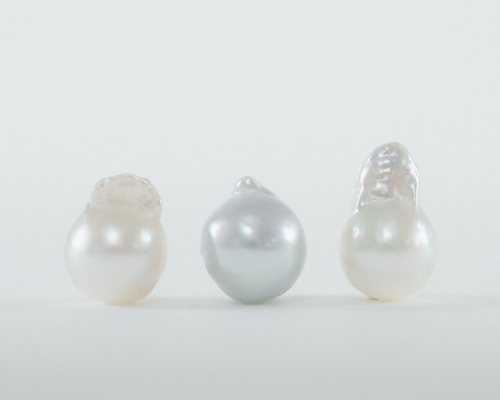
Round, and everything else. A different shape does not make a lesser pearl.
How to choose a pearl

Above, the difference in luster. Below, body colors and overtones side by side.
Luster
Look at how sharply the light reflects on the surface. The thicker and more even the nacre, the more directly light bounces back, and the clearer that reflection becomes. In natural window light, see whether your fingertip or the window frame appears on the pearl.
A pearl with weak luster looks softly clouded. That difference changes how a pearl reads on the hand far more than size does.
Color
The color of an Akoya pearl is easier to read in two layers. The first is the body color, the ground tone of white, cream or silver. The second is the overtone laid thinly over it, a faint pink, green or blue that appears as the angle of light changes.
No color ranks above another. A body color close to your skin settles quietly, a pink overtone lifts the complexion, and a pearl with green or blue reads calmer and more grown up.
Shape
There is no correct shape for a baroque pearl. The one your eye stops on when you pick it up is the right shape for you.
Living with a pearl
Pearls are soft as gemstones go. They have nothing like the hardness of a diamond or a sapphire, and they scratch when they rub against metal or other stones. Nacre is also vulnerable to acid, so perspiration, cosmetics and perfume can dull the surface over time.
The order you put them on
Put them on last, and take them off first. Letting makeup and perfume settle before the pearls go on keeps most of it off the surface.
After wearing
Wipe them gently with a soft cloth to lift away perspiration and skin oils. Never soak them, and never use an ultrasonic cleaner or detergent, both of which damage nacre.
Storing them
Keep them separate from other jewelry so nothing rubs against them. Avoid direct sunlight and very dry places. Pearls also fare better when they are worn from time to time rather than left in a box for years.
If the surface starts to look clouded, bring the piece to the gallery in Daikanyama. Cleaning is complimentary for life on every pearl bought from ANNA DIAMOND.

After wearing, wipe the pearl gently with a soft cloth before putting it away.
Pearl jewelry at ANNA DIAMOND

Akoya pearl ring
72,600 JPY

Akoya pearl open ring
121,000 JPY

Akoya pearl diamond earrings (pair)
121,000 JPY

Akoya pearl bracelet
154,000 JPY

Hug the World Necklace with Akoya Pearls
154,000 JPY

Reshine ball necklace with Akoya
253,000 JPY

Reshine ball earrings with Akoya (pair)
66,000 JPY

Reshine ball long earrings with Akoya (pair)
66,000 JPY

Reshine ball ring natural gray Akoya
66,000 JPY
Every pearl piece begins with a baroque Akoya pearl from Uwajima and is made in workshops in Japan, in Yamanashi and Tokyo, one at a time, by skilled artisans. The collection includes rings, earrings, necklaces and bracelets.
Since the pearls are all shaped differently, no two pieces are the same. When one of them holds your attention, that piece is the only one of its kind.
You can see the whole collection on the Uwajima unique Akoya pearl page.


From our clients and our staff. Swipe to see more.
Frequently asked questions
How are Akoya pearls different from South Sea or freshwater pearls?
They grow in different animals and different water. Akoya pearls form inside the Akoya oyster in sheltered saltwater bays, notably in Japan. South Sea and Tahitian pearls grow in much larger tropical oysters and reach bigger sizes, while freshwater pearls come from mussels in lakes and rivers and vary widely in shape and color.
Is a baroque pearl lower in quality than a round one?
Roundness is a matter of shape, not of quality. The condition of a pearl is read in its luster and in how its nacre is layered, and baroque pearls can carry a very deep luster.
Can I wear pearls every day?
Yes. Pearls hold their condition better when they are worn than when they sit in a box. The one habit worth keeping is a gentle wipe with a soft cloth after a warm day.
Can I order a second piece with the same pearl?
An identical pearl cannot be harvested, so an exact match is not possible. We are glad to look for one with a similar character, either online or in the gallery.
Should I take my pearls off on days I wear perfume?
There is no need to leave them behind. Apply perfume first, let it settle on the skin, and put the pearls on last so that nothing sprays directly onto them.
After your purchase

Each piece is finished by hand, one at a time. In the unlikely event that something goes wrong, a two year quality guarantee covers the piece. Returns are accepted within seven days, cleaning is complimentary for life at the Daikanyama gallery, and payment in installments is available with no added fee.
Seeing them in person

Luster and shape are the two things a photograph cannot carry. At the ANNA DIAMOND Gallery in Daikanyama, Tokyo, the Uwajima pearls can be tried on and bought in person. No appointment is needed.
There is further reading on this pearl in the Akoya pearl guide, and the pearls themselves can be compared on the Uwajima unique Akoya pearl page.
Related reading
Uwajima baroque Akoya pearl collection
Jewelry made with pearls that differ one by one
How ANNA DIAMOND looks at pearls
The basics, and how to care for them
Making use of the shell as well as the pearl